Tree lopping and tree pruning are not the same thing. Lopping is the aggressive removal of large branches or the entire top of a tree, usually to reduce size quickly. Pruning is a more precise, selective process that shapes the tree while keeping it healthy. In Melbourne, professional arborists avoid lopping for good reasons. Here is what you need to know.
What Is Tree Lopping?
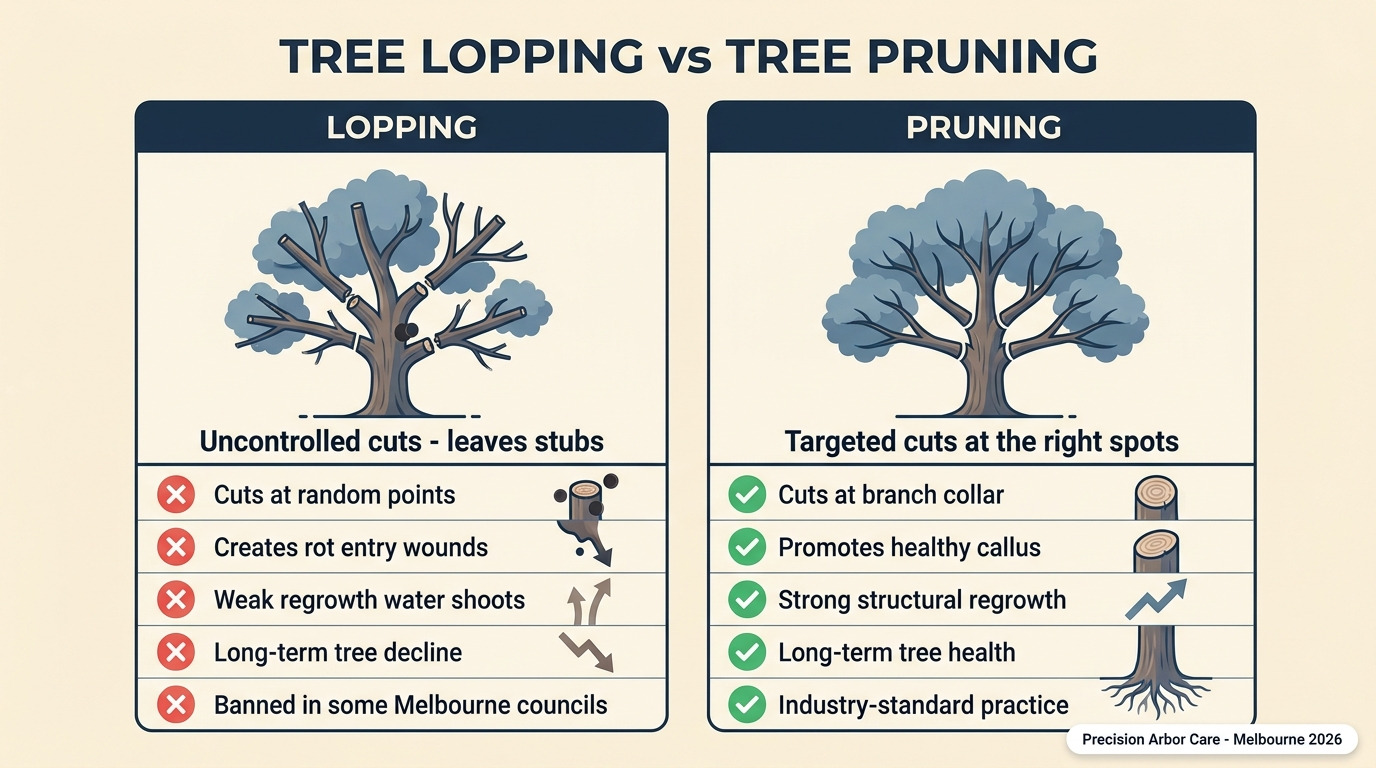
Lopping is the practice of cutting back branches to arbitrary points — often stubs or fork points — without regard for the tree’s natural form or biology. Topping (removing the entire crown) is the most extreme form of lopping.
Typical lopping involves:
- Removing large sections of the canopy
- Cutting branches back to thick stubs
- Removing 50% or more of the tree’s foliage in one session
- Making large-diameter cuts that the tree cannot seal
Lopping is quick and cheap. A crew can lop a tree in half the time a proper prune would take, which is why some operators still offer it.
What Is Tree Pruning?
Pruning is selective branch removal done for a specific goal — health, clearance, structure, safety, or appearance. Pruning follows established arboricultural principles:
- Cuts are made at specific points (just outside the branch collar)
- No more than 25% of live canopy is removed in one session
- The tree’s natural shape is maintained or improved
- Cut diameters are kept small where possible to aid sealing
- The work considers tree biology — species, age, season, health
Done properly, pruning keeps the tree healthy and can extend its life.
Key Differences: Side by Side
| Factor | Lopping | Pruning |
|---|---|---|
| Goal | Quickly reduce size | Improve health, shape, or safety |
| Cut placement | Random stubs or fork points | Just outside branch collar |
| Amount removed | 30-100% of canopy | 10-25% of canopy |
| Wound size | Large — hard to seal | Small to medium — seals well |
| Tree stress | Severe | Minimal |
| Regrowth | Weak water sprouts | Healthy natural growth |
| Cost | Lower per job | Higher per job |
| Long-term cost | High — more work needed soon | Lower — years between jobs |
Why Professional Arborists Avoid Lopping
It Damages the Tree
Lopping removes the leaves the tree needs to produce food. A severely lopped tree has to burn through stored energy to survive, leaving it weak for years. Some lopped trees never recover.
It Creates Decay
Large lopping cuts rarely seal completely. Water enters, rot sets in, and hollows form. Five to ten years after lopping, the tree often has internal decay that was invisible from outside.
It Creates Hazardous Regrowth
After lopping, trees respond with “epicormic growth” — fast, weakly-attached shoots growing from the sides of cut branches. These shoots can snap off in storms, creating the hazard the lopping was meant to prevent.
It Shortens the Tree’s Life
Research shows topped and lopped trees have significantly reduced lifespans. The ongoing stress, decay, and structural weakness lead to premature death, usually within 10-20 years.
Australian Standard AS 4373 Forbids It
The Australian Standard for pruning amenity trees (AS 4373-2007) specifically prohibits topping and lopping. Qualified arborists follow this standard. Operators who lop are either unqualified or ignoring the standard.
When People Confuse Lopping With Real Work
Some of what people call “lopping” is actually legitimate arboricultural work:
- Crown reduction: Selectively shortening branches back to suitable lateral branches that will take over as the new tips. Reduces size without creating stubs.
- Crown thinning: Removing selected branches throughout the canopy to reduce density without changing the overall shape.
- Deadwooding: Removing dead and dying branches only. Keeps the tree safe without touching live growth.
- Crown lifting: Removing lower branches to clear pedestrian or vehicle space.
These are all forms of pruning done to professional standards. If someone calls their service “lopping” but means one of these, the name is wrong but the work may be fine — ask to see the specifics of what they will do.
What to Ask Before Hiring
To make sure you are getting pruning, not lopping, ask the operator:
- Are you a qualified arborist? Look for AQF Level 3 or higher in Arboriculture.
- Do you follow AS 4373? The Australian Standard for tree pruning.
- How much of the canopy are you removing? If more than 25%, ask why.
- Where will the cuts be made? “At the branch collar” is the right answer.
- Will any branches be topped or headed back to stubs? The answer should be no.
- Are you insured? At least $10 million public liability.
A qualified arborist will answer these clearly. A cheap operator often cannot.
When a Tree Needs Real Size Reduction
If your tree is genuinely too big for its spot, there are three legitimate options:
- Crown reduction — carefully reduce size by a professional using proper techniques. Works for trees that are somewhat oversized.
- Staged reduction — smaller cuts over 2-3 seasons instead of one big cut. Gentler on the tree.
- Tree removal — if the tree is massively oversized, removal and replacement with a suitable species may be the honest answer. See our tree removal services.
Lopping as a “quick fix” usually leads to a worse outcome — a weakened, ugly tree that eventually needs to be removed anyway.
Get Proper Pruning From a Qualified Arborist
Precision Arbor Care provides AQF-qualified tree pruning across Melbourne, following Australian Standard AS 4373. We do not offer lopping or topping. If your tree genuinely needs size reduction, we will tell you honestly what the options are. Call Rob on 0410 266 708 for an on-site assessment, or see our tree pruning services. For more on common pruning errors, read our guide on 7 pruning mistakes that can kill your tree.
The Real Definitions
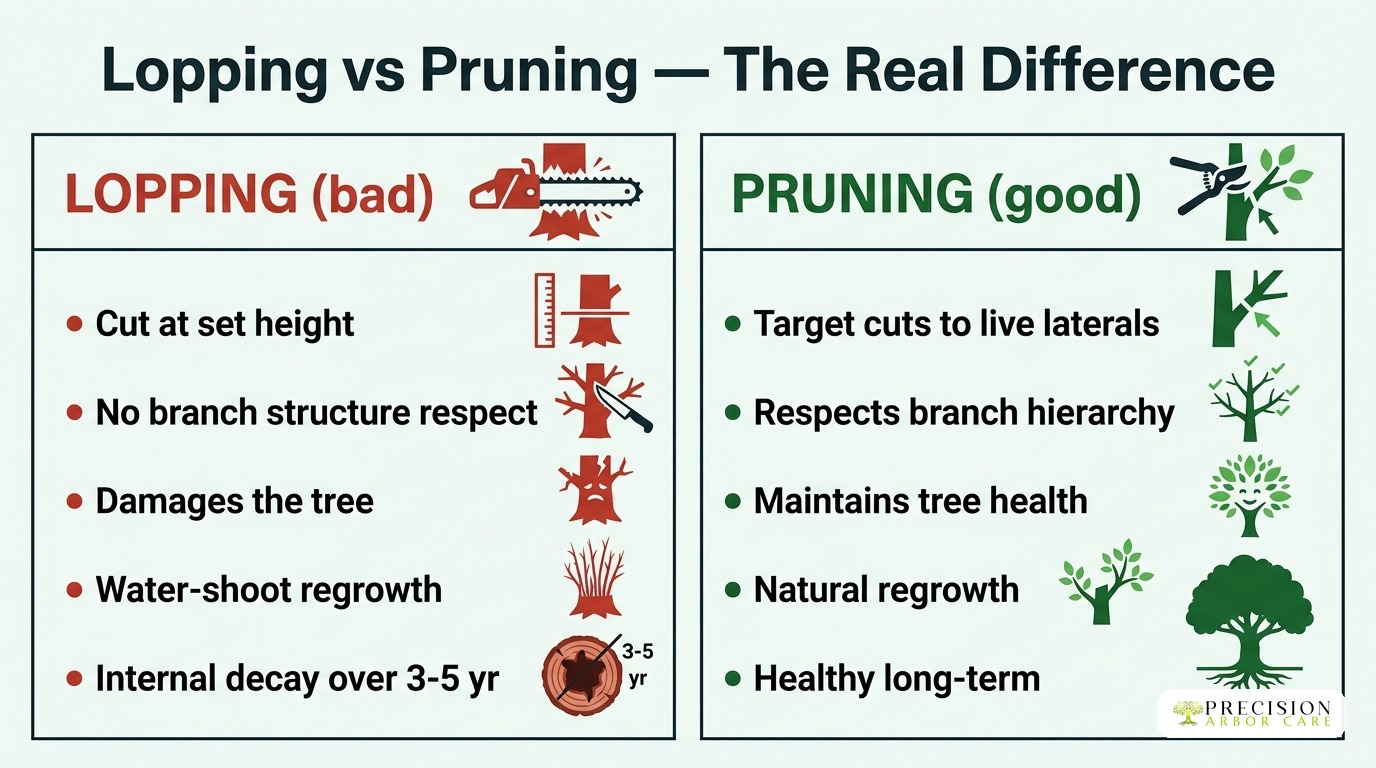
- Cutting at a set height
- No regard to branch structure
- Damages the tree
- Cheap and fast
- Unprofessional practice
- Target cuts to live laterals
- Respects branch hierarchy
- Maintains tree health
- Skilled, takes longer
- Professional standard
Why Some Operators Still Lop
Lopping is faster, requires less skill, and looks like "more work" per dollar to homeowners who don’t know better. It’s still common because:
The Three-Year Damage Pattern
Trees that have been lopped follow a predictable decline:
- Year 1: Water-shoot regrowth from the cut points. Looks bushy but structurally weak.
- Year 2-3: Decay enters the open wounds. Internal rot begins.
- Year 4-7: Major limb failures from the water-shoot junctions. Often dangerous [1].
Never accept "lopping" on a quote
Any quote that mentions "lopping" or "cutting the height down" is a red flag. Reputable arborists prune, reduce, or remove — never lop. Walk away from lopping quotes.
Keep reading
More tree pruning guides
Ready when you are
Get a free, fixed tree-care quote — usually the same day
When you get in touch, here’s what happens: Rob calls you back personally, usually the same day. We talk through the job, book an on-site visit within 24-48 hours if it needs one, and give you a written, fixed-price quote with every line itemised. No pushy sales, no "we’ll see when we start" pricing, no surprise extras at the end.
Servicing Melbourne metropolitan and outer suburbs. Email: info@lc.boostable.au

Written by
Rob Tufuga
Founder & Lead Arborist, Precision Arbor Care
Rob has been climbing, cutting and shaping trees across Melbourne for more than 15 years. He started Precision Arbor Care to do tree work the way he always wished he could when he worked for bigger crews — one job at a time, no upselling, and an honest number on the quote. He still personally inspects every job over $1,000 and answers the phone himself whenever he’s not up a tree.
Need a tree out, a hedge trimmed, or a stump ground? Call Rob on 0410 266 708 or request a quote online.