In Victoria, you cannot just clear native vegetation off your block — most clearing on properties over a certain size, or in mapped overlays, requires a planning permit. Removal without one can attract fines from $1,000 to $300,000 and an order to revegetate. This guide explains when you need a permit, when you do not, and how the application process works for Melbourne and regional Victoria.
The Two Layers of Vegetation Rules
Two separate rule systems control land clearing in Victoria:
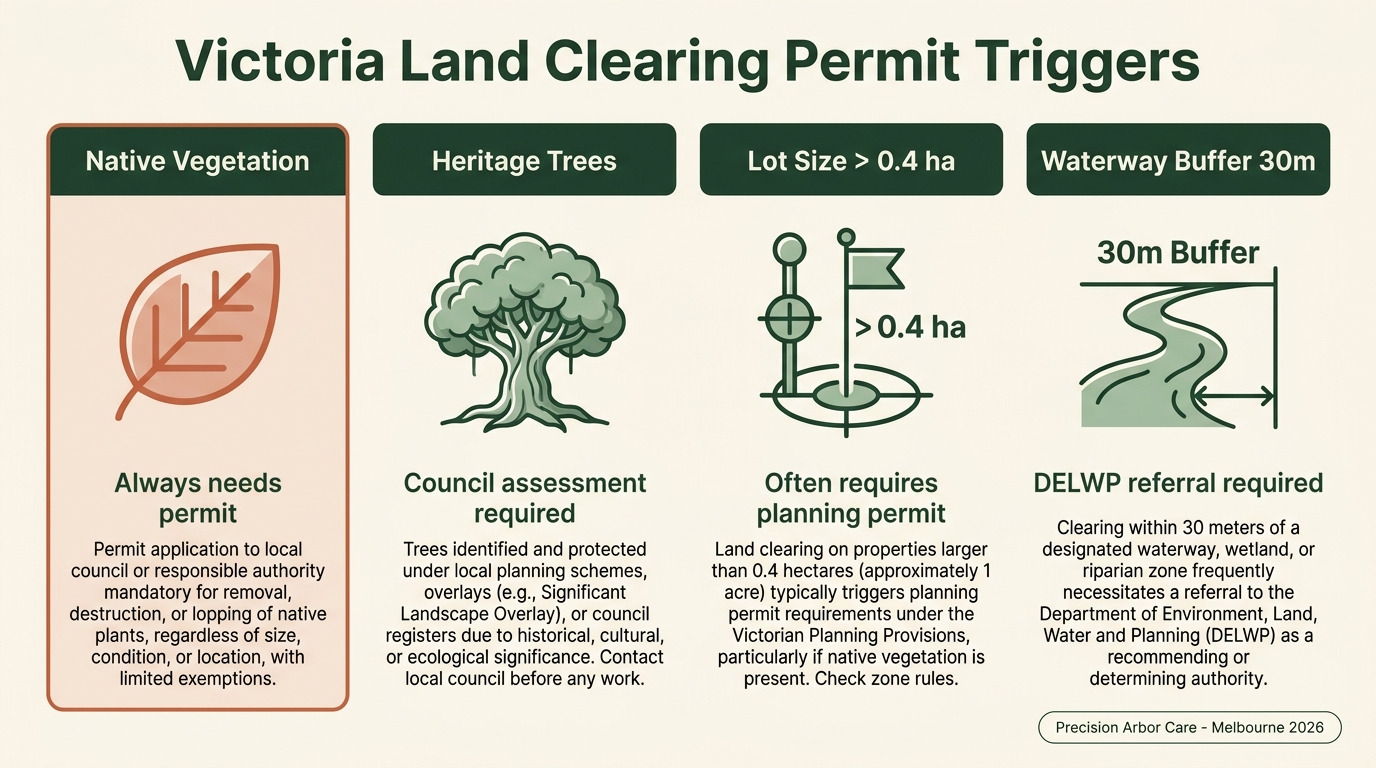
- State-wide native vegetation regulations — administered through the Victoria Planning Provisions. These apply on any block over 0.4 hectares (1 acre) regardless of council.
- Local council planning overlays — additional rules in zones the council has identified as ecologically or visually significant.
You can be exempt under one and still need a permit under the other.
When You Need a Permit
You usually need a permit if any of these apply:
- You want to remove, lop, or destroy any native vegetation on a block of 0.4 hectares or more
- Your property has a Vegetation Protection Overlay (VPO)
- Your property has a Significant Landscape Overlay (SLO)
- Your property has an Environmental Significance Overlay (ESO)
- Your property has a Bushfire Management Overlay (BMO)
- The vegetation is listed in your council’s Significant Tree Register
- You want to remove a tree on the nature strip (council land — always need approval)
When You Probably Do Not Need a Permit
Most blocks under 0.4 hectares (1 acre) with no overlays do not need a state-level permit for clearing on the residential portion. You may still need a permit under your council’s local tree protection law if the trees exceed a certain trunk size — see our guide on tree removal permits in Melbourne.
Standard exemptions usually include:
- Removal within 10 metres of a dwelling for fire protection
- Removal within 4 metres of a fence boundary line
- Removal of declared noxious weeds (blackberry, gorse, broom, willow)
- Removal of dead vegetation (proof may be required)
- Limited routine maintenance of existing managed gardens
How to Check Your Block
Step 1 — Check the Planning Property Report
Go to the Victorian Planning Maps website (planning.vic.gov.au), enter your address, and download the Planning Property Report. The report lists every zone, overlay, and special control affecting your block.
Step 2 — Look for These Overlays
If you see any of these on the report, you almost certainly need a planning permit before clearing:
- VPO — Vegetation Protection
- SLO — Significant Landscape
- ESO — Environmental Significance
- BMO — Bushfire Management
Step 3 — Check the Native Vegetation Regulations
If the block is over 0.4ha, you also need to meet the requirements under the state-wide native vegetation rules. The complexity of the application depends on the area being cleared:
- Location risk A or B with low area — basic application
- Location risk C or area over 1ha — detailed application with an ecologist report
How to Apply for a Land Clearing Permit
- Contact your local council planning department to confirm what permits apply
- Engage a qualified ecologist or arborist for any required vegetation assessment
- Prepare a clearing plan showing what will be removed, what will stay, and how vegetation will be replaced (some permits require offset planting)
- Submit the planning permit application with fees ($200-$2,000 depending on scale)
- Wait for assessment — typical timeframes are 4-12 weeks; complex applications can take longer
- Receive permit conditions and complete works within the permit timeframe
What an Offset Looks Like
If your clearing affects native vegetation, the permit usually requires an offset — replanting equivalent native vegetation elsewhere or paying into a state-managed offset fund. The cost depends on the habitat value of what is being removed. For most residential rural blocks, offset cost ranges from $1,500 to $20,000.
Penalties for Clearing Without a Permit
Unauthorised native vegetation removal carries significant penalties:
- On-the-spot fines from around $1,000
- Court-imposed fines up to $328,000 for individuals and over $1.6 million for corporations
- Enforcement orders requiring replanting and ongoing management for years
- Stop-work orders that halt any related construction
Councils take this seriously. Aerial photography is checked against earlier imagery, and many reports come from neighbours.
When You Need a Permit Fast (Hazard Removal)
Where a tree is genuinely hazardous and needs to come down quickly, councils have emergency processes. You will need:
- An arborist report (Level 5 consulting arborist) confirming the hazard
- Photos showing the defect, lean, decay, or damage
- A clearing plan showing only the hazardous tree is being removed
Some councils can issue an emergency clearing approval within days; others still take 2-3 weeks.
How We Help
For most land clearing jobs we can:
- Check your Planning Property Report for overlays
- Tell you whether your situation needs a permit, an arborist report, or neither
- Quote on the clearing work itself
- Connect you with a Level 5 arborist or ecologist when reports are required
For pricing details see our guide to land clearing costs in Melbourne.
Get a Free Quote
Call Rob on 0410 266 708 for a free site assessment, or see our land clearing services. Permits are the slowest part of any clearing project — the earlier you start, the sooner the work can happen.
Three Permit Categories for Victoria Land Clearing
- Single small trees on private property
- Exempt species
- Small lot residential
- Under 0.5ha rural
- Maintenance pruning
- Large native vegetation areas
- Indigenous species clearing
- Native grassland clearing
- Threatened species habitat
- Significant lot rural clearing
Timeline for Permit Approval
Federal vs State vs Council Layer
Land clearing in Victoria has three layers of rules: federal (EPBC Act for threatened species), state (Native Vegetation Regulations under the Planning and Environment Act), and council (local vegetation protection overlays). Most residential clearing only triggers the council layer [1].
Permit complexity assessment
Free assessment of which permits your job needs. We’ll walk through the council, state, and federal layers and tell you what applications are required.
Keep reading
More land clearing guides
Ready when you are
Get a free, fixed tree-care quote — usually the same day
When you get in touch, here’s what happens: Rob calls you back personally, usually the same day. We talk through the job, book an on-site visit within 24-48 hours if it needs one, and give you a written, fixed-price quote with every line itemised. No pushy sales, no "we’ll see when we start" pricing, no surprise extras at the end.
Servicing Melbourne metropolitan and outer suburbs. Email: info@lc.boostable.au

Written by
Rob Tufuga
Founder & Lead Arborist, Precision Arbor Care
Rob has been climbing, cutting and shaping trees across Melbourne for more than 15 years. He started Precision Arbor Care to do tree work the way he always wished he could when he worked for bigger crews — one job at a time, no upselling, and an honest number on the quote. He still personally inspects every job over $1,000 and answers the phone himself whenever he’s not up a tree.
Need a tree out, a hedge trimmed, or a stump ground? Call Rob on 0410 266 708 or request a quote online.