A dangerous tree does not always look dangerous. Trees can appear healthy from the outside while rotting from the inside. They can stand for years with a hidden defect, then fail without warning during a storm. Knowing what to look for could protect your family, your home, and your neighbours.
Here are five signs that a tree on your property might be a hazard — and what to do about each one.
1. Dead or Hanging Branches
Dead branches are the most common sign of a problem. They are also the most dangerous because they can fall at any time, not just during storms.
What to Look For
- Branches with no leaves during the growing season (spring and summer)
- Branches with brown, brittle leaves that do not drop
- Hanging or broken branches caught in the canopy (sometimes called “widow makers”)
- Bark peeling away from individual branches, exposing dry wood underneath
What to Do
A single dead branch does not necessarily mean the whole tree is failing. But dead branches should be removed by a qualified arborist before they fall. If a branch is hanging or partially detached, stay clear of the area underneath and call for removal as soon as possible.
Regular deadwooding (removing dead branches from the canopy) is one of the simplest ways to keep a tree safe. Precision Arbor Care carries out deadwooding across Greater Melbourne suburbs as part of routine tree maintenance.
2. The Tree Is Leaning More Than It Used To
Some trees grow at an angle naturally. That is normal. The concern is when a tree that was previously straight starts to lean, or when an existing lean gets worse.
What to Look For
- A noticeable change in angle compared to how the tree looked a year ago
- Soil heaving or cracking on the side opposite the lean — this means the roots are pulling out of the ground
- Exposed roots on the tension side (the side the tree is leaning away from)
- Leaning toward a target — a house, shed, fence, driveway, or footpath
What to Do
A new or worsening lean is serious. It often means the root system is failing. If you see cracked or heaving soil around the base, the tree could come down soon. Keep people away from the lean side and call an arborist for an urgent assessment.
3. Cracks or Splits in the Trunk
The trunk is the main structural support of the tree. Any visible damage to the trunk is worth investigating.
What to Look For
- Vertical cracks running up the trunk — these can indicate internal decay or structural weakness
- Deep splits where the trunk forks into two or more stems (called a co-dominant stem failure)
- Cavities or hollows in the trunk — some hollowing is normal in mature trees, but large cavities reduce structural strength
- Bark falling off in large sections, especially if the wood underneath is soft, wet, or crumbly
What to Do
Not every crack means the tree is about to fall. Some trees live for decades with trunk cavities. But cracks at a fork, or cracks combined with a lean, are high-risk signs. An arborist can assess whether the remaining wood is strong enough to support the tree, or whether removal is the safest option.
4. Fungal Growth at the Base or on the Trunk
Fungi on a tree are a visible sign of internal decay. The mushrooms or brackets you see on the outside are the fruiting bodies of fungi that are breaking down the wood inside.
What to Look For
- Mushrooms growing at the base of the tree or from surface roots
- Bracket fungi (shelf-like growths) on the trunk — these are often hard, woody, and semicircular
- Soft, spongy wood when you press on the trunk or exposed roots
- Sawdust-like material (frass) at the base, which can indicate insect activity alongside fungal decay
What to Do
Fungal growth near the base of a tree is the most concerning location. The base and root plate carry the entire weight of the tree. If decay has compromised this area, the tree can fail at ground level and topple completely.
Some fungal species are more aggressive than others. An arborist can identify the species and assess how much internal wood loss has occurred. In some cases, the tree can be retained with monitoring. In others, dead tree removal is the safest course of action.
5. Root Heave or Damage to the Root Zone
Roots anchor the tree in the ground. When roots are damaged or decayed, the tree loses its ability to stand up, regardless of how healthy the canopy looks.
What to Look For
- Soil lifting or cracking in a circle around the base of the tree
- Exposed roots that have been cut, crushed, or paved over
- Recent construction work near the tree — trenching, excavation, or soil compaction within the root zone (which extends well beyond the canopy drip line)
- The tree rocking in the wind more than neighbouring trees of a similar size
What to Do
Root damage is hard to see because most of it happens underground. If you have had construction work done near a tree in the last 1-3 years and the tree starts dropping branches or leaning, the two are likely connected.
A tree with severe root damage may not recover. An arborist can carry out a root zone assessment and advise whether the tree can be saved or needs to come down.
When to Call an Arborist vs When It Is Urgent
Some situations can wait a few days. Others cannot.
Book a routine assessment if:
- You have noticed one or two dead branches in the canopy
- There is minor fungal growth on the trunk
- You want a general health check on an older tree
Call for an urgent assessment if:
- A large branch is hanging or partially detached
- The tree has developed a sudden lean with soil movement at the base
- A large crack has appeared in the trunk, especially at a fork
- The tree is already leaning toward your house, a power line, or a public footpath
Precision Arbor Care offers same-day or next-day assessments for urgent dangerous tree situations across Melbourne.
Get Your Tree Assessed
If any of these signs sound familiar, do not wait for a storm to make the decision for you. Call Rob at Precision Arbor Care on 0410 266 708 for a professional assessment. We service all Greater Melbourne suburbs and can advise whether the tree needs pruning, treatment, or safe removal.
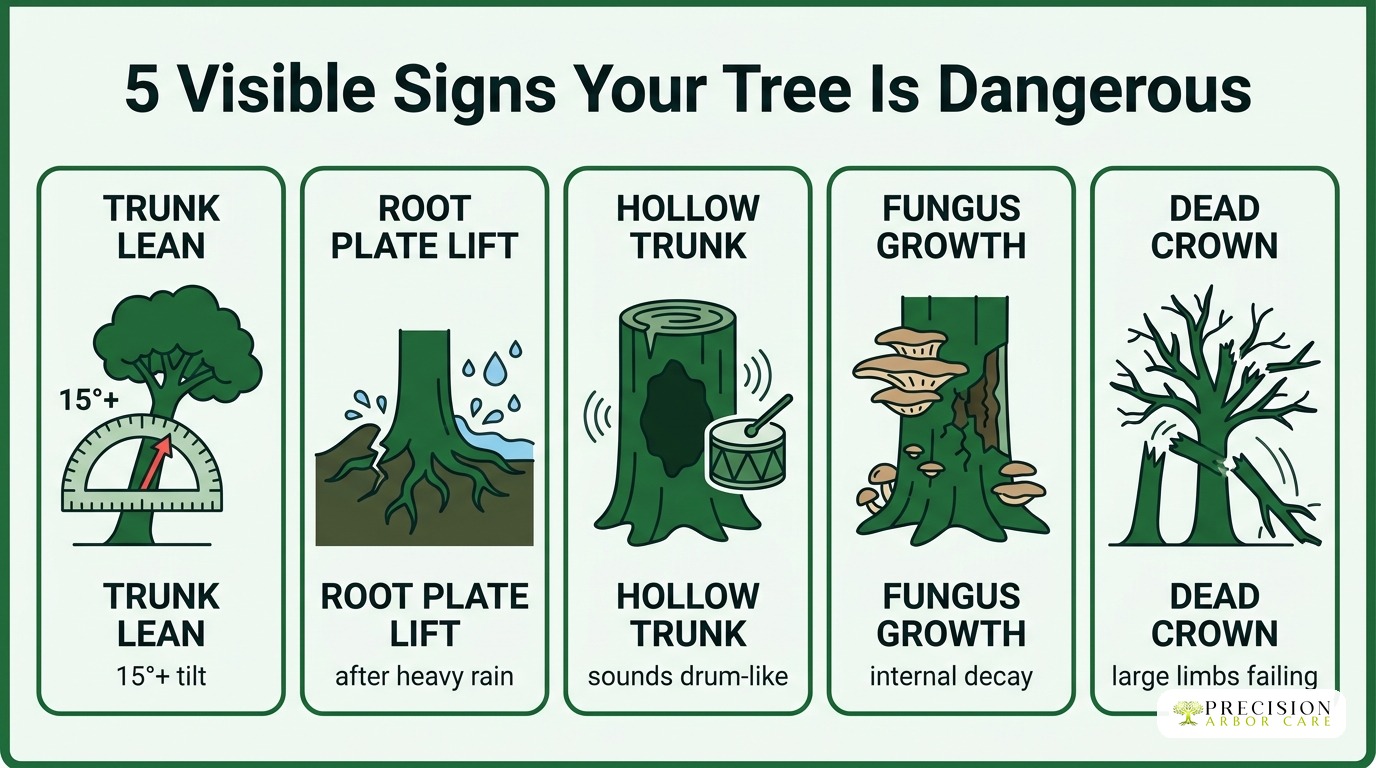
The Five Signs Ranked by Severity
Not all warning signs carry the same risk. Across hundreds of inspections, we’ve learned which signs predict imminent failure vs which need monitoring:
- Visible root plate lift after rain
- Trunk lean exceeding 15°
- Hollow trunk (drum sound)
- Major dead limbs over structures
- Recent fungus growth on trunk
- Small bark damage
- Single dead branches
- Minor leaf drop
- Bird/insect cavities
- Small cracks healing well
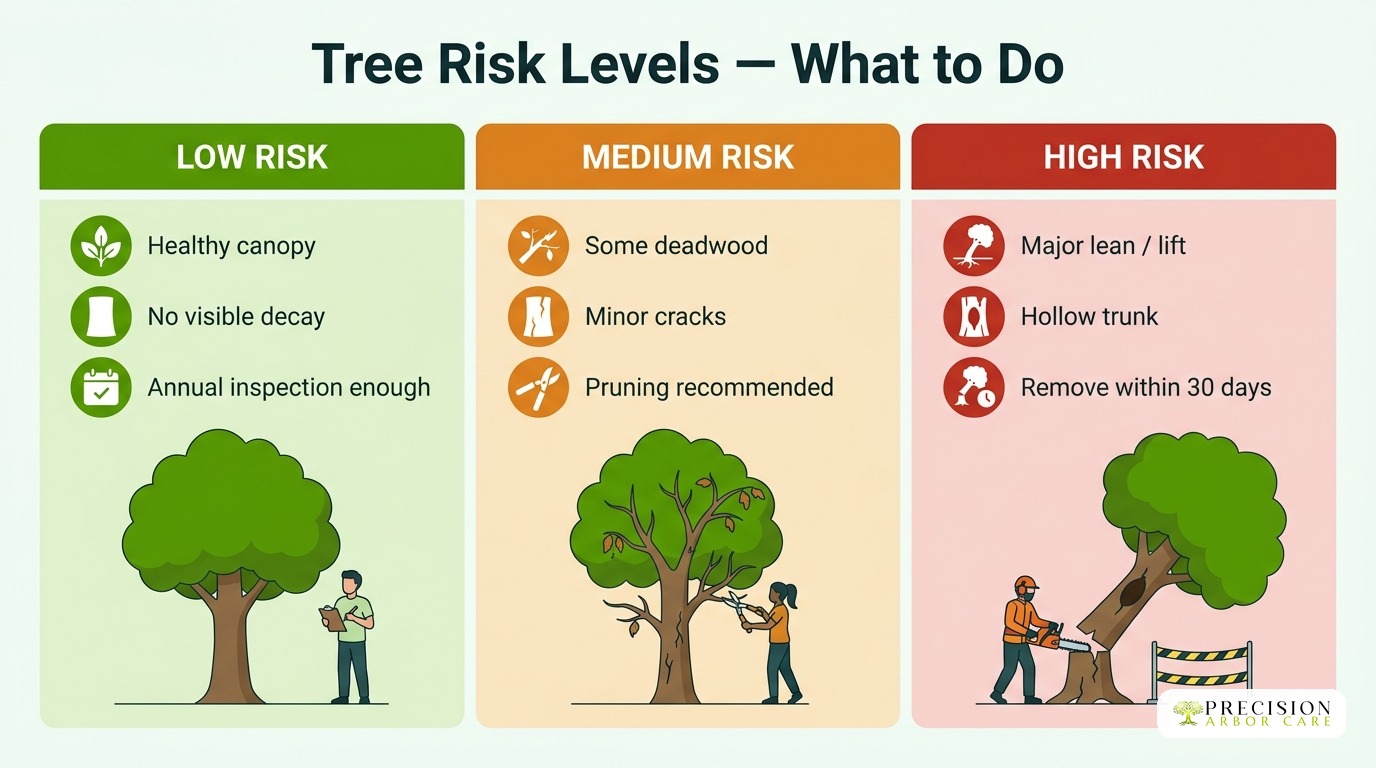
What "Risk to Property" Actually Means
When to Get an Independent Arborist Report
If you’re considering a removal because the tree feels risky, an independent arborist report ($200-$500) often pays for itself. It tells you whether the risk is real, whether pruning solves it, and provides the documentation your insurer wants if anything happens [1].
Free risk assessment
Send Rob a photo and we’ll tell you whether it’s low / medium / high risk for free. Useful if you’re not sure whether to book a full assessment.
Keep reading
More arborist advice
Ready when you are
Get a free, fixed tree-care quote — usually the same day
When you get in touch, here’s what happens: Rob calls you back personally, usually the same day. We talk through the job, book an on-site visit within 24-48 hours if it needs one, and give you a written, fixed-price quote with every line itemised. No pushy sales, no "we’ll see when we start" pricing, no surprise extras at the end.
Servicing Melbourne metropolitan and outer suburbs. Email: info@lc.boostable.au

Written by
Rob Tufuga
Founder & Lead Arborist, Precision Arbor Care
Rob has been climbing, cutting and shaping trees across Melbourne for more than 15 years. He started Precision Arbor Care to do tree work the way he always wished he could when he worked for bigger crews — one job at a time, no upselling, and an honest number on the quote. He still personally inspects every job over $1,000 and answers the phone himself whenever he’s not up a tree.
Need a tree out, a hedge trimmed, or a stump ground? Call Rob on 0410 266 708 or request a quote online.