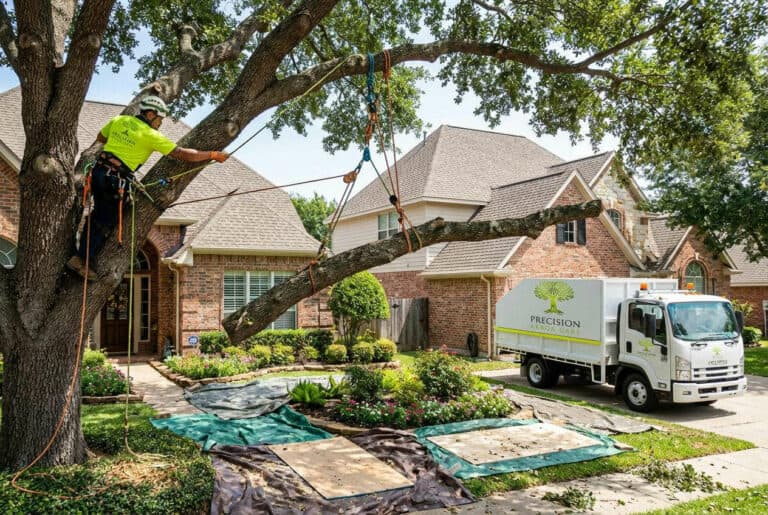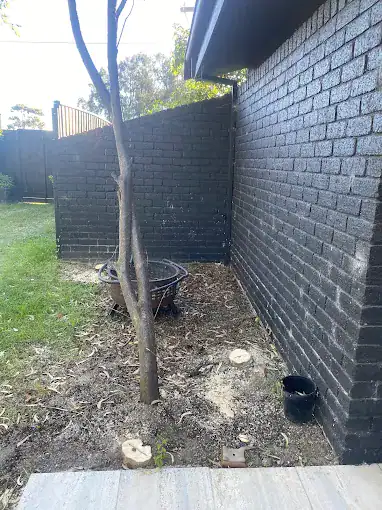
After tree removal you often end up with a pile of fresh wood chips — sometimes a lot of them. Most homeowners ask whether it is worth keeping. The short answer is yes — fresh wood chips have at least five practical uses in a Melbourne garden, and using them on-site saves disposal fees too. This guide covers what to do with wood chips, and what to avoid.
How Much Mulch Comes From One Tree?
Rough rule of thumb — a single 8-10 metre tree produces around 2-4 cubic metres of chip. That is enough to:
- Mulch 30-60 square metres of garden bed at 50mm deep
- Cover a 5m x 5m area for a path or play surface
- Fill the back of a 6×4 trailer twice
Most clients keep what they can use and we take the rest away.
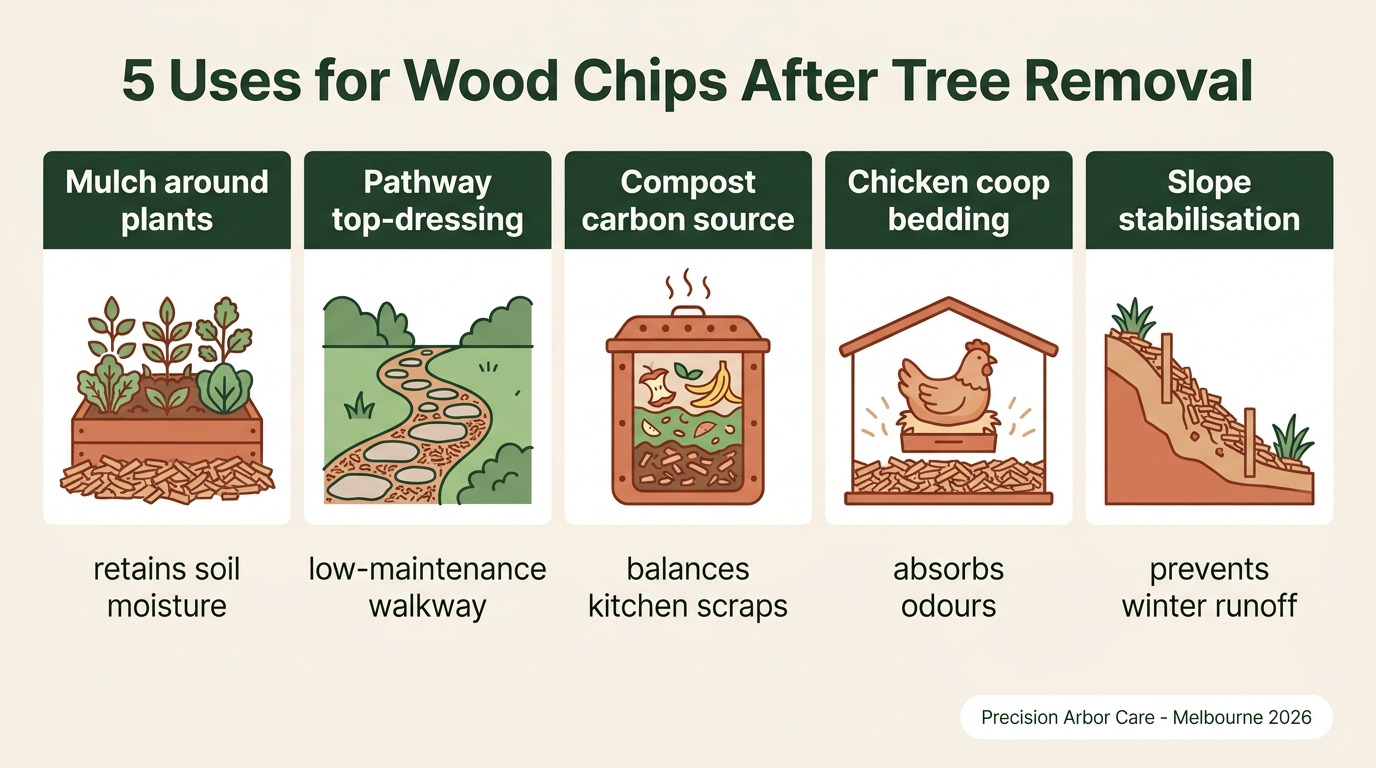
1. Garden Bed Mulch
This is the most common use. Spread fresh chip 50-75mm thick around shrubs, fruit trees, and ornamentals. Mulch:
- Reduces water loss from the soil — important through Melbourne summers
- Suppresses weeds without herbicide
- Moderates soil temperature
- Slowly breaks down and adds organic matter to the soil
Keep the chip 10cm away from the base of trunks and stems — mulch piled against bark traps moisture and causes rot (the “volcano mulching” mistake).
2. Around Established Trees
The best mulch for a tree is the tree’s own chip. A wide circle of mulch around an established tree, extending out to the drip line, mimics a forest floor and is the single best thing you can do for tree health. Apply 50-100mm thick, keep clear of the trunk flare, and top up every 12-18 months as it breaks down.
3. Pathways
Fresh chip makes a soft, springy, low-cost path. It works well for:
- Connecting paths through a vegetable garden or orchard
- Side-yard walking paths between fence and house
- Informal woodland or bush garden paths
Lay 100-150mm thick and edge with timber or galvanised steel edging to keep it in place. Top up annually as it compacts and breaks down.
4. Play Surface Underneath Cubbies and Swing Sets
Wood chip is one of the cheapest soft-fall surfaces. The Australian Standard for impact-attenuating surfaces (AS 4422) recognises wood chip as suitable for playground equipment up to a certain fall height — typically 1.5-2 metres at 200mm depth.
For backyard cubbies and swing sets this is fine. Lay 200mm thick over a flat, well-drained base and edge it with timber. Refresh and top up every year.
5. Weed Suppression in Big Areas
If you have a large area you want to keep weed-free without spraying — under a deck, a rough section of the yard, behind a shed — wood chip works as a smother. Lay it 100-150mm thick directly on the existing weeds or grass. Most weeds will not push through that depth.
For best results, mow first, then lay overlapping cardboard sheets, then the chip on top. The cardboard breaks down in 6-12 months and gives the smother an extra layer.
What to Avoid
Do Not Dig Fresh Chip Into the Soil
Fresh wood chip steals nitrogen from the soil as it breaks down. As a surface mulch it does not matter — the soil underneath is still fine. But mix fresh chip into the topsoil and you will see yellowing leaves and poor growth in everything nearby. If you want to incorporate chip, compost it for 6-12 months first.
Do Not Mulch Around Vegetables With Fresh Chip Alone
Same nitrogen issue. For vegetable beds use composted mulch or sugar cane / pea straw instead. Fresh chip is fine on paths between vegetable beds.
Be Careful With Pine and Eucalypt Chip on Acid-Sensitive Plants
Pine chip is mildly acidic and slow to break down. Eucalypt chip contains oils that can suppress some plants. Most Australian native gardens tolerate eucalypt mulch fine, but vegetable gardens and tropicals can struggle. Test with a small area first if you are not sure.
Do Not Mulch Where Termites Are a Concern
Termites do not eat mulch, but mulch piled against the foundation of a house can hide termite activity. Keep mulch 30cm clear of the wall.
How to Compost Wood Chip Faster
If you want chip that is safe to dig into soil:
- Pile it 1.5m high and 2m wide minimum (smaller piles do not heat up)
- Add a layer of fresh lawn clippings or manure to add nitrogen
- Turn the pile with a fork or front-loader every 4-6 weeks
- Keep it moist but not soaking
- After 6-9 months the chip should be dark, crumbly, and earthy-smelling
Should You Have the Chip Taken Away Instead?
Some clients have no use for chip — small inner-city blocks with no garden beds, or apartment owners with body-corporate-managed grounds. In those cases we take all the chip off-site to a green waste facility. It is composted there and used commercially.
If your block has any garden beds at all, it is worth keeping at least a cubic metre for mulching.
Related Reading
For what happens to the stump after we remove the tree, see what to do with the mulch after stump grinding.
Get a Free Quote
Precision Arbor Care can chip on-site, take chip away, or leave a pile for you. Just let Rob know what you prefer when you book. Call 0410 266 708 or learn more about our wood chipping and mulching services.
What Type of Mulch You Actually Got
Chipped wood from different species behaves differently in the garden. Some break down fast (6-12 months), some last 2-3 years. Knowing what you have helps you use it right:
- Plane Tree
- Liquidambar
- Cypress
- Fruit trees
- Most ornamentals
- Eucalypt heartwood
- Spotted Gum
- Hardwood Wattle
- Pine heartwood
- River Red Gum
Best Garden Uses Ranked
What NOT to Do With Fresh Chip
Fresh wood chip from a tree removal is high in nitrogen-demanding microbes and can "starve" nearby plants of nitrogen during the first 3-6 months of decomposition. Three rules:
- Don’t mix into soil. Surface mulching only. Mixing fresh chip into planting beds causes nitrogen drawdown.
- Don’t pile against trunks. Keep mulch 5cm clear of trunk bark to prevent collar rot.
- Don’t use under acid-loving plants if from Eucalypt. Eucalypt chip is acidic and will affect soil pH for natives, blueberries, hydrangeas [1].
Free mulch advice on the day
When we finish a job we’ll tell you what species the chip is, where it’s best used, and where to avoid spreading it. Tailored to your garden.
Keep reading
More arborist advice
Ready when you are
Get a free, fixed tree-care quote — usually the same day
When you get in touch, here’s what happens: Rob calls you back personally, usually the same day. We talk through the job, book an on-site visit within 24-48 hours if it needs one, and give you a written, fixed-price quote with every line itemised. No pushy sales, no "we’ll see when we start" pricing, no surprise extras at the end.
Servicing Melbourne metropolitan and outer suburbs. Email: info@lc.boostable.au

Written by
Rob Tufuga
Founder & Lead Arborist, Precision Arbor Care
Rob has been climbing, cutting and shaping trees across Melbourne for more than 15 years. He started Precision Arbor Care to do tree work the way he always wished he could when he worked for bigger crews — one job at a time, no upselling, and an honest number on the quote. He still personally inspects every job over $1,000 and answers the phone himself whenever he’s not up a tree.
Need a tree out, a hedge trimmed, or a stump ground? Call Rob on 0410 266 708 or request a quote online.