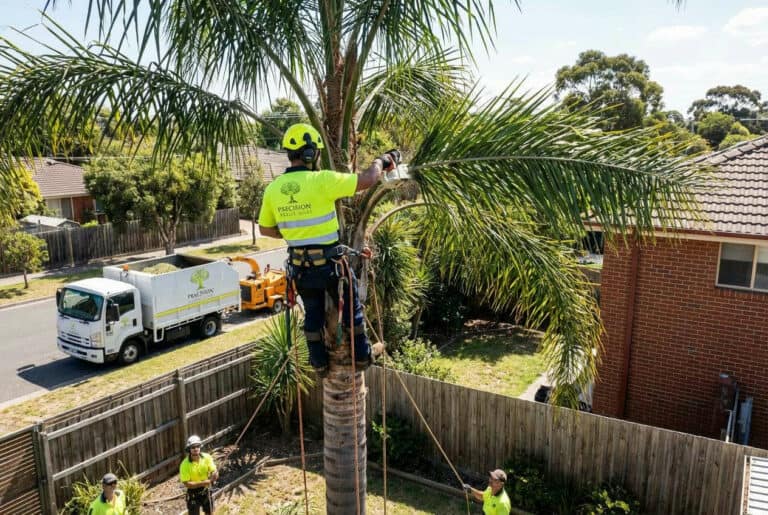
Many Melbourne backyards have no rear vehicle access — a house at the front, fences on both sides, and a tree that needs to come down at the back of the block. Tight access tree removal solves this. Instead of using a crane or truck, the climber takes the tree apart section by section and carries every piece out through the house, side gate, or over a fence. This guide explains how tight access removal works, when it is needed, and how it affects the cost.
What Counts as a Tight Access Job
Tight access is any tree removal where standard equipment cannot reach the tree. The trigger is usually one of these:
- No rear lane access — fences on every side, only a side gate
- Side gate too narrow — under 90cm, a chipper will not fit
- Boundary fence backs onto another property — no neighbouring access
- Pool, deck, or hardscape in the way — can’t drop sections directly
- House on a hillside — equipment can’t reach the rear yard
- Apartment courtyard — material has to come out through a unit
If a 5-tonne mini-tipper and a chipper cannot park within 15 metres of the tree, the job is tight access.
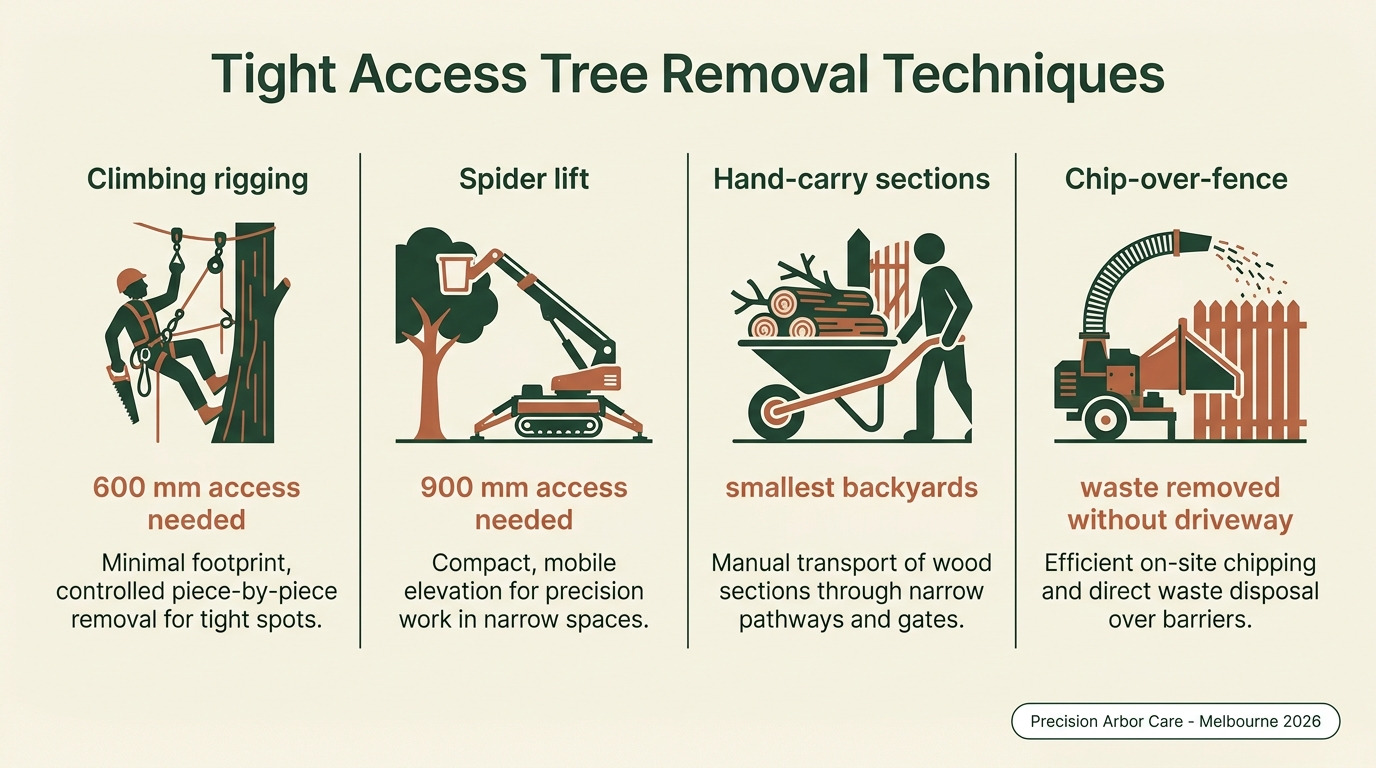
How Tight Access Removal Works
Step 1 — Assess the Path In and Out
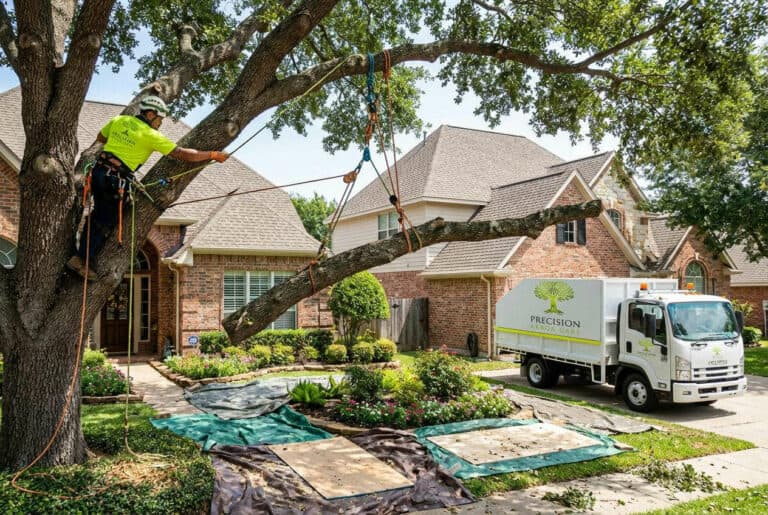
Before we start, we walk the route material will take. We measure the side gate, count the steps, check for awkward corners, and note anything that needs to be protected (pool tiles, decking, garden beds, irrigation). We lay boards to protect lawns and clients are surprised by our care.
Step 2 — Set Up Climbing Lines
The climber sets two ropes — one to climb on, and a separate lowering line for each section of the tree. The lowering rope runs through a friction device and out to a ground anchor. Every cut is controlled, lowered slowly, and never just dropped.
Step 3 — Section the Tree
Starting from the top, the climber takes the tree apart in pieces small enough to:
- Be lowered safely without damaging anything below
- Be carried by one or two people
- Fit through the access path on the way out
For a 12m gum in a tight backyard, this can mean 60-100 cuts. The smaller the access, the smaller the sections, the longer the job.
Step 4 — Process and Remove
The ground crew carries every piece out and chips or stacks it streetside. For most tight access jobs the chipper sits on the nature strip and the crew runs material back and forth. Branches get chipped; trunk sections are usually cut into log lengths and trucked off.
Step 5 — Stump Treatment
For stump grinding in tight access we use a portable narrow stump grinder — a machine 60-75cm wide that fits through most side gates. Some grinders are even smaller. The grinder is wheeled in, chained to a tree or fence post for stability, and ground manually.
Why It Costs More
Tight access jobs take 50-200% longer than open access work on the same tree. A 10m gum in an open backyard might be 4 hours; the same tree in a tight access yard could be 8-10 hours. Cost goes up roughly proportionally.
The main cost drivers:
- More manual labour to carry every section out
- Slower, more careful sectioning to fit the access path
- Extra protection equipment for paths, lawn, decks, and pools
- More climbing time as each cut requires a controlled lower
Through-the-House Removal
For some inner-city Melbourne properties — terraces, semi-detached homes, narrow blocks — there is genuinely no other way out. We can remove a tree by carrying material through the house. This adds a different set of considerations:
- Hallway floor protection (heavy carpet runners or hardboard sheets)
- Doorway width check — anything over 90cm can be a problem
- Stair access if material has to come up from a basement
- Removing pictures from walls in the hallway
- Cleanup of dust, leaves, and sawdust afterwards
Through-the-house jobs are slower again — usually a full day for what would otherwise be a 3-hour removal.
What We Need From You
Before a tight access job, please make sure:
- Side gates are unlocked or you can be on-site to unlock them
- Any padlocks are removed temporarily if we need to widen the route
- The path from the tree to the street is clear of furniture, bins, and washing lines
- Pets are secured indoors or in a separate area
- Cars are off the driveway so the chipper can park as close as possible
What We Will Not Do
For safety and for your property, we will not:
- Drop sections without a controlled lower onto pools, decks, or pavers
- Run chainsaws inside a house
- Carry green waste through a tenant’s unit without their permission
- Remove a tree that genuinely needs a crane just because the homeowner wants to avoid the crane fee
Tight Access vs Crane Removal
Sometimes a crane is the safer option — even at a higher cost. For trees over 15 metres or with a heavy lean, the choice between climbing and craning depends on:
- Whether the street is wide enough to land a crane
- Whether there is enough overhead clearance for the boom
- Cost comparison — for very large trees, crane can be cheaper than 2 days of climbing
Get a Free Quote
Precision Arbor Care does tight access tree removal all over Melbourne — narrow inner-city blocks, hilltop houses, courtyard apartments. Send Rob photos of the tree and the access path and we will give you a clear quote. Call 0410 266 708 or see our tight access tree removal services.
Tight Access — Why It Costs 30-50% More
The difference between a tree we can drive a truck up to and a tree behind a 1m side gate is everything. Tight-access work needs a different gear loadout, more hand-carrying, and longer site time:
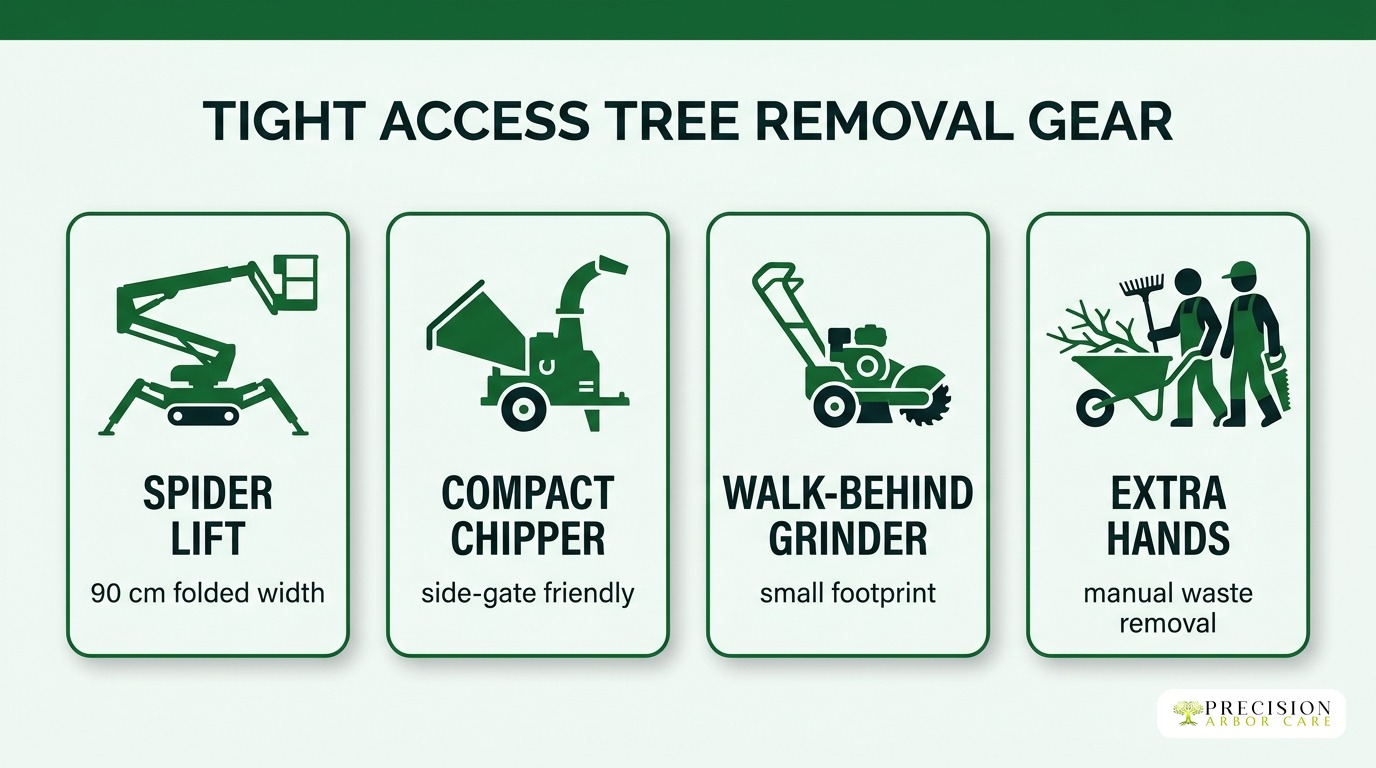
The Gear We Bring to Tight-Access Jobs
- 3.5-tonne chipper
- Stump grinder on tow
- Climber + spare gear
- Crew of 3-4
- Half-day average
- Compact spider-lift (1m wide)
- Mini grinder (walk-behind)
- Extra ground crew
- Tarps + plywood pads
- Full-day average
Spider Lift — The Game-Changer
For genuinely tight access (1m gate, side passage, courtyard properties), spider lifts have changed the game. A modern spider lift folds to 90cm wide for transport, extends to 18-22m of working height, and runs on electric for low-noise indoor-yard work. Adds $400-$800 to the job vs climb-only but cuts time by 30-40% [1].
Tight access quote process
We always inspect tight-access jobs on-site — measuring gate widths and turning radius matters too much to quote on photos alone. Site visit is free.
Keep reading
More tree removal guides
Sources
Ready when you are
Get a free, fixed tree-care quote — usually the same day
When you get in touch, here’s what happens: Rob calls you back personally, usually the same day. We talk through the job, book an on-site visit within 24-48 hours if it needs one, and give you a written, fixed-price quote with every line itemised. No pushy sales, no "we’ll see when we start" pricing, no surprise extras at the end.
Servicing Melbourne metropolitan and outer suburbs. Email: info@lc.boostable.au

Written by
Rob Tufuga
Founder & Lead Arborist, Precision Arbor Care
Rob has been climbing, cutting and shaping trees across Melbourne for more than 15 years. He started Precision Arbor Care to do tree work the way he always wished he could when he worked for bigger crews — one job at a time, no upselling, and an honest number on the quote. He still personally inspects every job over $1,000 and answers the phone himself whenever he’s not up a tree.
Need a tree out, a hedge trimmed, or a stump ground? Call Rob on 0410 266 708 or request a quote online.