Pruning at the wrong time can stress a tree, encourage disease, or trigger a flush of weak growth. Pruning at the right time helps the tree heal faster, grow stronger, and stay healthy for years. Melbourne’s climate gives us clear seasonal windows for different types of pruning. Here is a practical guide for homeowners.
Why Timing Matters
When you cut a branch, you create a wound. The tree needs energy to seal that wound and prevent infection. If you prune at a time when the tree is already under stress — during a heatwave, a growth flush, or just before winter dormancy ends — it has fewer resources to recover.
Timing also affects how pests and diseases spread. Some fungal diseases are most active in warm, wet conditions. Pruning during those periods creates open entry points right when the pathogens are looking for one.
Getting the timing right is not complicated. It comes down to knowing whether your tree is deciduous or evergreen, native or exotic, and what type of pruning it needs.
The General Rule for Melbourne
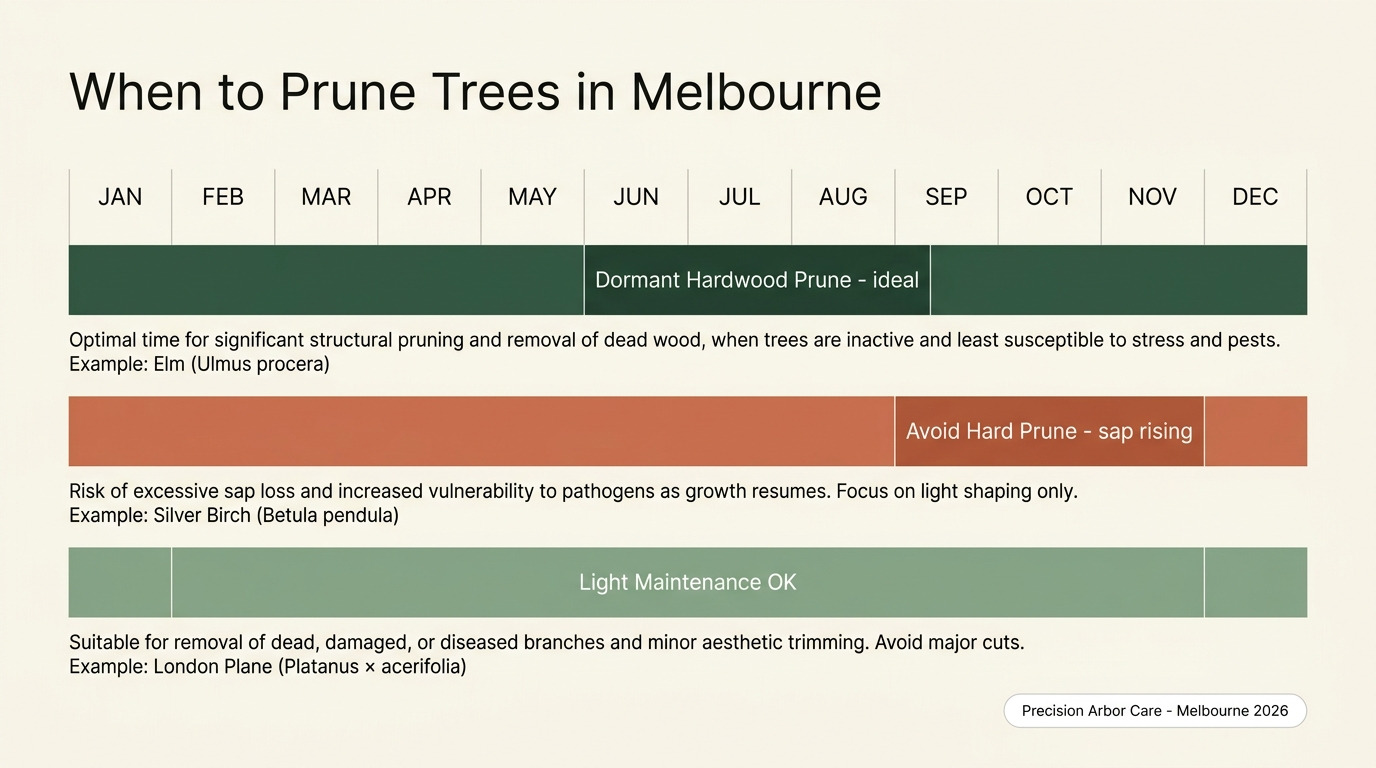
Late autumn through winter (May to August) is the best time to prune most trees in Melbourne.
During this period:
- Deciduous trees are dormant, so pruning causes minimal stress
- Sap flow is low, reducing bleeding from cuts
- Most fungal diseases and insect pests are less active
- The tree’s structure is visible without leaves, making it easier to see what needs to go
- Growth resumes in spring, so wounds begin healing quickly after pruning
There are exceptions, and they matter. Read on for specifics by tree type.
Pruning Native Trees in Melbourne
Australian native trees follow different rules than European and deciduous exotics. Many natives are evergreen and grow year-round in Melbourne’s temperate climate.
Eucalyptus (Gum Trees)
Eucalyptus species are best pruned in late summer to early autumn (February to April). This is after the main growth flush and before the wet, cool months when fungal activity increases. Avoid pruning eucalyptus in spring when sap flow is highest — heavy sap bleeding can weaken the tree.
Eucalyptus are also prone to sudden branch drop, particularly in hot weather. If you notice dead or hanging branches on a gum tree during summer, have them removed promptly regardless of the season.
Melaleucas (Paperbarks and Tea Trees)
Prune after flowering, which for most Melbourne melaleucas is late summer to early autumn. Light shaping and deadwood removal can be done at any time.
Acacias (Wattles)
Wattles are short-lived trees (10-20 years for most species). Prune after flowering to maintain shape. Heavy pruning is generally not recommended — wattles do not respond well to hard cuts and can die back rather than regrow.
Callistemons (Bottlebrush)
Prune immediately after flowering, usually late spring to early summer. Cut just behind the spent flower to encourage bushy regrowth and more flowers next season.
Pruning Exotic and Deciduous Trees
Deciduous trees — the ones that drop their leaves in autumn — are the most straightforward. Prune them while they are dormant.
Best Window: June to August
This covers most deciduous trees common in Melbourne gardens:
- Oaks — Prune in winter. Avoid spring and summer when oak leaf blister and other diseases are active.
- Elms — Winter pruning only. Elms are susceptible to Dutch Elm Disease, and beetles that spread it are active in warmer months.
- Maples — Late winter (July to August). Maples bleed sap heavily if pruned in late winter or early spring, but this is cosmetic and does not harm the tree. Avoid autumn pruning.
- Ornamental plums, cherries, and pears — Late winter, before bud swell. This is also a good time to shape young trees.
- Birches — Prune in late summer to early autumn, or in winter. Birches bleed heavily if pruned in late winter or spring.
Fruit Trees
Fruit trees have their own pruning calendar:
- Citrus — Prune in late winter to early spring (August to September), after the last frost risk and before the new growth flush.
- Apple and pear — Prune in winter while dormant. Summer pruning can be done lightly to control size.
- Stone fruit (peach, plum, apricot, cherry) — Prune in late summer to early autumn, after harvest. Winter pruning increases the risk of bacterial and fungal diseases entering through cuts.
Types of Pruning and When Each Applies
Not all pruning is the same. The type of work needed affects when it should be done.
Deadwooding
Removing dead, dying, or broken branches. This can be done at any time of year. Dead wood is a safety hazard and should not wait for the ideal pruning season.
Crown Thinning
Selectively removing branches throughout the canopy to improve light and air flow. Best done during the recommended seasonal window for the species. Crown thinning reduces wind resistance and can help prevent storm damage.
Crown Lifting
Removing lower branches to increase clearance underneath the tree — for vehicles, pedestrians, or to let light reach the ground. Best done in the dormant season for deciduous trees, or late summer to autumn for evergreens.
Crown Reduction
Reducing the overall size of the canopy by shortening branches back to a suitable growth point. This is more aggressive than thinning and should only be done during the optimal pruning window for the species. Poor timing or technique can lead to dieback.
Precision Arbor Care provides all types of pruning for residential and commercial properties across Greater Melbourne. We match the pruning method and timing to the species and situation.
When NOT to Prune
There are times when pruning does more harm than good:
- During a heatwave — Trees are already stressed. Pruning removes shade canopy and increases water loss.
- During or just after heavy rain — Wet conditions promote fungal infection through fresh cuts.
- In early spring during bud burst — The tree is spending energy on new growth. Pruning now wastes that energy.
- When the tree is sick or stressed — Unless you are removing diseased branches to stop the spread, avoid pruning a tree that is struggling. It needs its canopy to produce energy for recovery.
If you are not sure whether now is the right time, ask a qualified arborist. A quick phone call can save your tree years of recovery.
Book Your Pruning with Rob
Call Rob at Precision Arbor Care on 0410 266 708 to schedule pruning at the right time for your trees. We service all Greater Melbourne suburbs and can advise on the best pruning approach for your specific trees and property. Free quotes provided on-site.
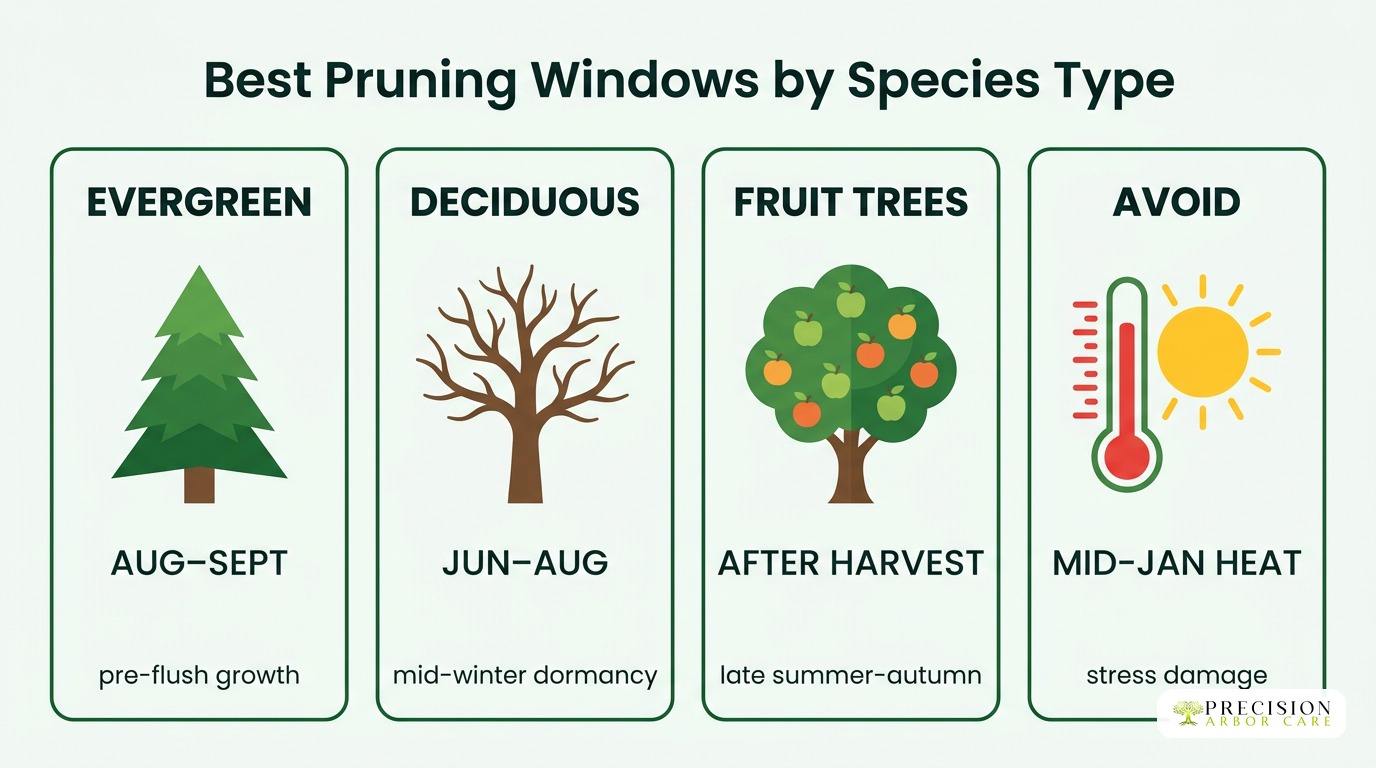
By Tree Type — Best Pruning Window
What Wrong-Time Pruning Costs
- Dormant season major cuts
- Pre-spring shape work
- Post-fruit fruit-tree work
- Cool morning timing
- Light cuts year-round
- Mid-Jan heat hard cuts
- Wet-bark spring cuts
- Major work during flowering
- Storm-season heavy work
- Hard cuts on stressed trees
Species Where Timing Really Matters
Three species where wrong-time pruning is the most common cause of decline we see:
- Fruit trees pruned at wrong time. Reduces next season’s crop, can introduce disease through wet-wood cuts.
- Crepe Myrtle pruned hard in summer. Loses entire flower display, stress decline over 2-3 years.
- Maples pruned in active sap flow. Heavy sap bleeding weakens the tree and attracts borers [1].
Free pruning timing advice
Photo the tree, tell Rob the species (or just describe leaves/bark), and he’ll tell you the optimal pruning window for your specific tree. Saves you bookings at the wrong time.
Keep reading
More tree pruning guides
Ready when you are
Get a free, fixed tree-care quote — usually the same day
When you get in touch, here’s what happens: Rob calls you back personally, usually the same day. We talk through the job, book an on-site visit within 24-48 hours if it needs one, and give you a written, fixed-price quote with every line itemised. No pushy sales, no "we’ll see when we start" pricing, no surprise extras at the end.
Servicing Melbourne metropolitan and outer suburbs. Email: info@lc.boostable.au

Written by
Rob Tufuga
Founder & Lead Arborist, Precision Arbor Care
Rob has been climbing, cutting and shaping trees across Melbourne for more than 15 years. He started Precision Arbor Care to do tree work the way he always wished he could when he worked for bigger crews — one job at a time, no upselling, and an honest number on the quote. He still personally inspects every job over $1,000 and answers the phone himself whenever he’s not up a tree.
Need a tree out, a hedge trimmed, or a stump ground? Call Rob on 0410 266 708 or request a quote online.