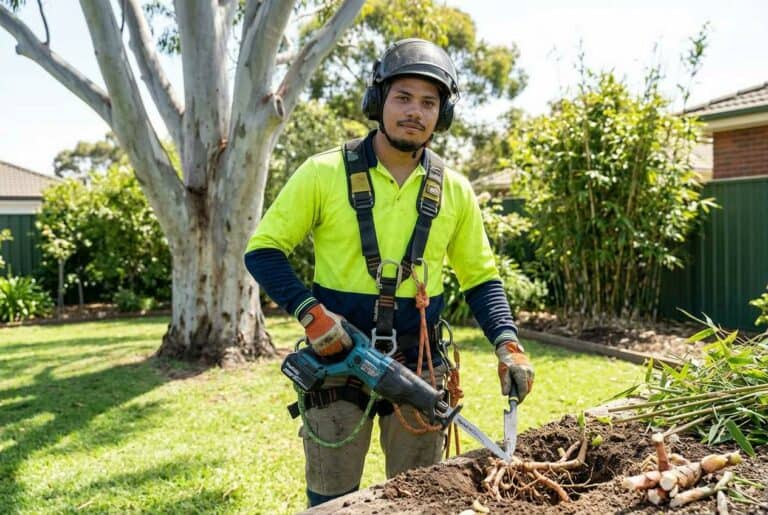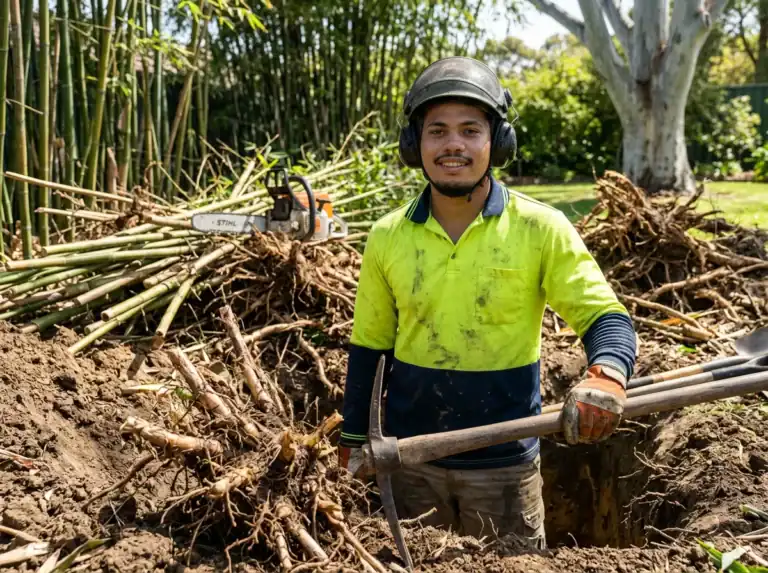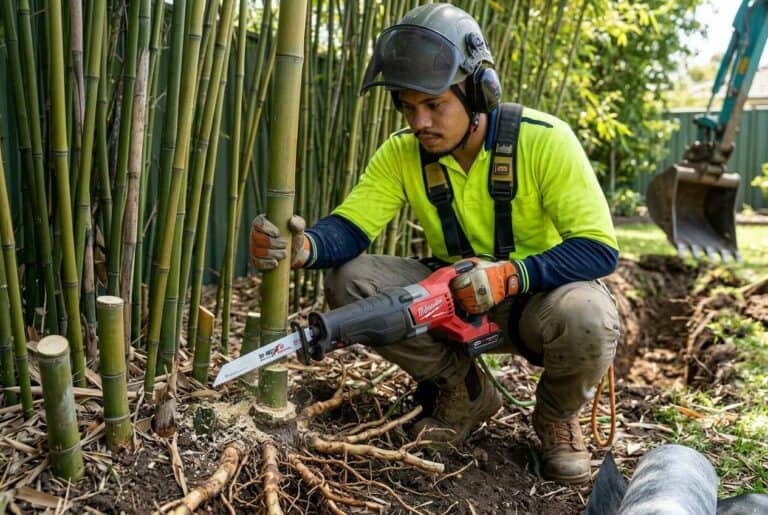
Bamboo is the fastest-spreading plant most Melbourne gardeners ever deal with. A small clump planted near a fence in spring can throw shoots into the neighbour’s yard, under the driveway, and through the lawn within a year or two. The reason comes down to one thing — the type of bamboo, and what its underground rhizomes do. This guide explains how bamboo spreads, why it gets out of control so fast, and what actually works to stop it.
How Bamboo Spreads
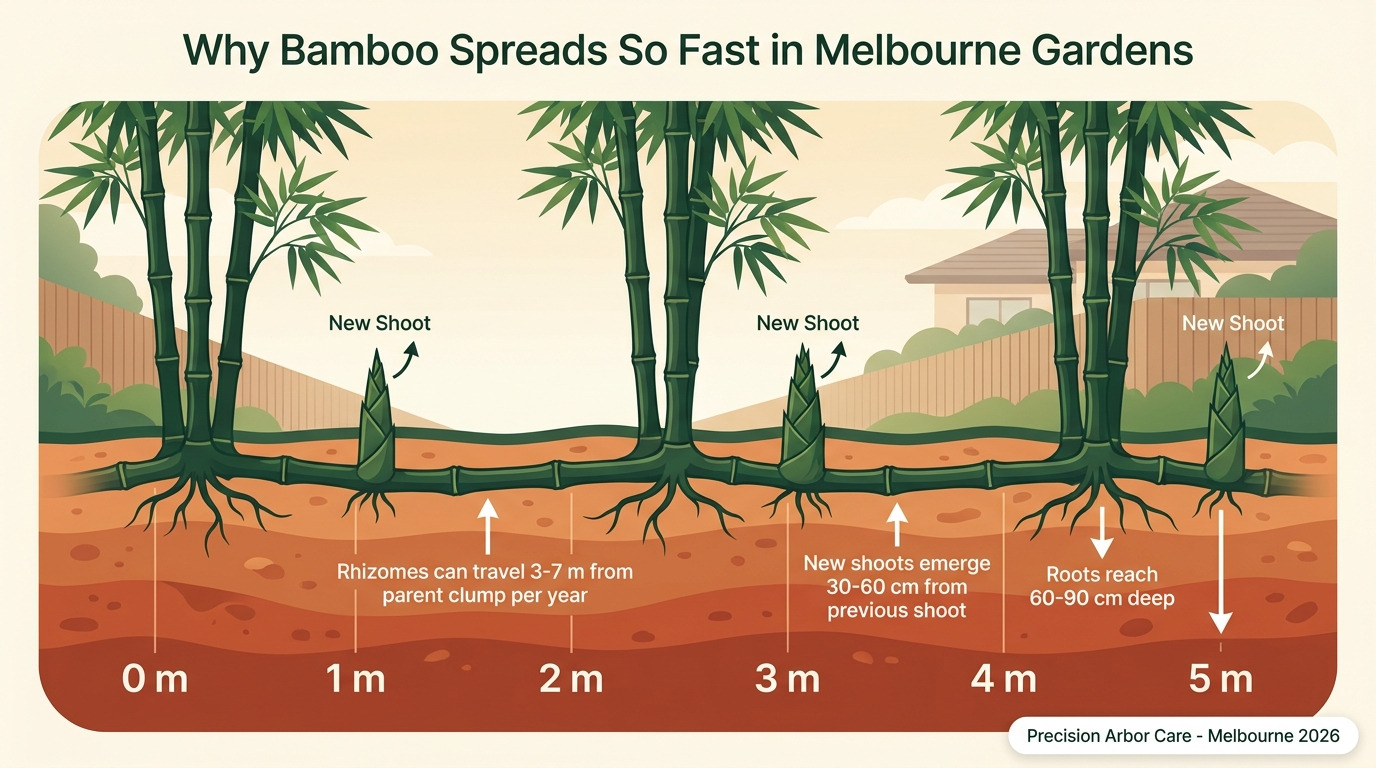
Bamboo does not spread by seed in Australia — almost all garden bamboo flowers and seeds only rarely, sometimes once a century. Bamboo spreads from rhizomes, which are underground stems that grow sideways and send up new shoots (culms) every spring.
How fast and how far the rhizomes travel depends entirely on which type of bamboo you have:
- Running bamboo — sends rhizomes 3 to 10 metres a year, sometimes more
- Clumping bamboo — rhizomes grow only 5 to 30cm from the parent plant per year
For more on telling the two apart see our guide on running vs clumping bamboo.
Why Running Bamboo Gets Out of Control
Running bamboo rhizomes travel underground at depths of 10-40cm. They follow the path of least resistance, which usually means:
- Along the inside of a fence line
- Under driveways and paths into the front yard
- Through garden beds and lawn
- Around and into drains, where the moisture is
Once a rhizome is established under a structure it sends shoots up wherever it finds soft soil or a crack. That is why bamboo can appear in the middle of a lawn 8 metres from the parent clump, or through a paver gap on the other side of the property.
Common Running Bamboos in Melbourne
The species we see most often are:
- Phyllostachys aurea (Golden Bamboo) — the most common invasive bamboo in Melbourne backyards
- Phyllostachys nigra (Black Bamboo) — popular feature plant, just as invasive
- Pseudosasa japonica (Arrow Bamboo) — shorter but very aggressive spreader
Some clumping bamboos sold as “non-invasive” still spread up to 30cm a year and slowly become a problem over a decade.
Why DIY Removal Usually Fails
Most people try to remove bamboo by cutting off the culms at ground level or pulling out the visible plant. This rarely works because:
- The rhizomes survive underground and re-shoot the next spring
- Cut culms regrow if any rhizome is still alive
- Herbicide sprayed on the leaves does not always reach the rhizomes
- Digging a clump out usually leaves rhizomes behind, especially near fences and paths
It is not unusual to remove a bamboo clump in winter and watch fresh shoots appear in spring from rhizome fragments left in the soil.
What Actually Works
For Small Clumps
Dig out the entire root mass. Use a sharp spade or root saw to chase rhizomes outward — they will radiate from the clump. Every rhizome fragment longer than 5cm with a node on it can sprout, so be thorough. Sift the soil if you can.
For Established Clumps
The most reliable approach is mechanical removal with an excavator or mini-digger, followed by 1-2 follow-up visits to remove regrowth. We typically:
- Cut all culms to ground level and chip them
- Excavate the root mass and all rhizomes within 2-3 metres of the clump
- Apply targeted herbicide to any rhizome fragments visible in the soil
- Return after 4-6 weeks to treat any regrowth before it establishes
For Spreading Bamboo Already Beyond the Clump
If rhizomes have travelled under a fence, driveway, or into a neighbour’s yard, the removal is more involved. Sometimes the only realistic option is a long-term containment program rather than total eradication — installing a 60cm-deep rhizome barrier and treating regrowth for 2-3 years.
How to Stop Bamboo Coming Back After Removal
After full removal, the best prevention is:
- Watch the area for two full springs and pull any new shoots immediately
- If you want to plant in the area, dig down 40cm before planting to check for missed rhizomes
- Consider a rhizome barrier (60cm-deep HDPE root barrier) if the bamboo was near a fence and the neighbour also has it
Should You Replant Bamboo?
If you love the look of bamboo, replant only clumping species in a contained spot — large pots, raised planters with sealed bases, or beds bordered by concrete on all sides. Avoid Phyllostachys, Pseudosasa, and any “running” type even if the label says it is well-behaved.
Get a Free Bamboo Removal Quote
Precision Arbor Care removes bamboo across Melbourne. We have the equipment to excavate large rhizome mats and the experience to know which clumps need a one-visit job and which need a longer follow-up program. Call Rob on 0410 266 708 for a free quote, or learn more about our bamboo removal services.
The Biology of Bamboo Spread
Why Running Bamboo Is the Real Problem
- Underground rhizomes spread 3-5m/yr
- Can travel under fences and paths
- Roots can break through tarmac
- Years of post-removal control needed
- Most invasive Melbourne pest
- Roots stay in tight clump
- Predictable footprint
- Easy to maintain boundary
- One-time removal sorts it
- Suitable as feature plant
Three Things That Make Bamboo Worse
Common gardening choices that turn manageable bamboo into a 10-year problem:
- Watering and fertilising. Encourages aggressive rhizome growth.
- Pruning canes incompletely. Stimulates new lateral runners.
- Planting in well-drained soil. Rhizomes travel faster in loose soil.
Free bamboo identification
Not sure if you’ve got running or clumping? Send Rob a photo of the canes (close-up of rhizome where visible). We’ll identify it in 24 hours.
Keep reading
More bamboo removal guides
Ready when you are
Get a free, fixed tree-care quote — usually the same day
When you get in touch, here’s what happens: Rob calls you back personally, usually the same day. We talk through the job, book an on-site visit within 24-48 hours if it needs one, and give you a written, fixed-price quote with every line itemised. No pushy sales, no "we’ll see when we start" pricing, no surprise extras at the end.
Servicing Melbourne metropolitan and outer suburbs. Email: info@lc.boostable.au

Written by
Rob Tufuga
Founder & Lead Arborist, Precision Arbor Care
Rob has been climbing, cutting and shaping trees across Melbourne for more than 15 years. He started Precision Arbor Care to do tree work the way he always wished he could when he worked for bigger crews — one job at a time, no upselling, and an honest number on the quote. He still personally inspects every job over $1,000 and answers the phone himself whenever he’s not up a tree.
Need a tree out, a hedge trimmed, or a stump ground? Call Rob on 0410 266 708 or request a quote online.